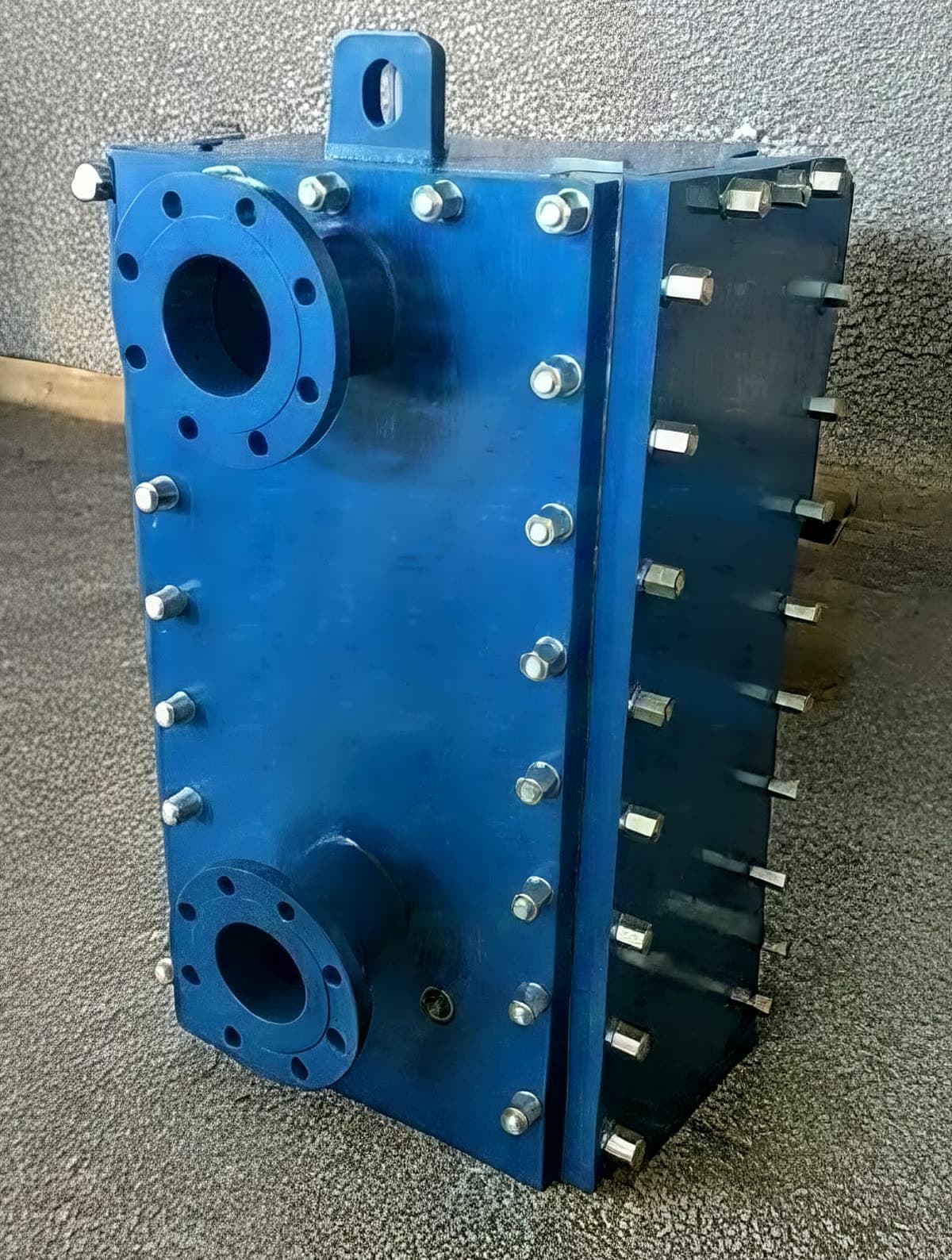
Deodorising heat recovery
Oil-to-oil interchange between the deodorised oil leaving the column and the bleached oil entering it.
Recommended type
Plate & Block Heat Exchanger
The economiser around the deodoriser is the largest single heat recovery on a refining line, and a plate surface earns its place by holding a close temperature approach. It is rarely one exchanger. At the hot end, deodorising runs at 240–260 °C under vacuum, above any elastomer (Viton included), so that stage is welded and the only question is which welded type. That question is decided by cleaning, because oil polymerises at these temperatures and the economiser is the duty that fouls. A plate & block opens on all four sides, so the channels can be rodded and washed out and the unit goes back together, which is why it leads. A spiral gives one wide continuous channel that is far slower to block in the first place. Plate & shell is deliberately not offered here: of the three it is the hardest to clean mechanically, and on a fouling service that is the whole question. Further down the train, where the interchange has already given up most of its heat and the metal is back inside what an elastomer will take, a gasketed pack on Viton is the better answer: it opens completely for cleaning, which on this duty is worth more than it costs.