
Selection · 12 October 2026
Welded block heat exchangers: a better alternative to shell & tube
 Watch the video on YouTube
For decades the choice in a process plant was simple. Shell & tube for anything hot, corrosive or under pressure. A gasketed plate heat exchanger for clean, moderate duties where efficiency mattered. The welded block heat exchanger, widely known by Alfa Laval's trade name Compabloc, removes most of that trade-off. It is built to stand up to duties where gaskets fail, and it transfers heat like a plate exchanger.
How it is built
- A stack of corrugated plates, welded to each other into a solid block. There are no gaskets between the plates.
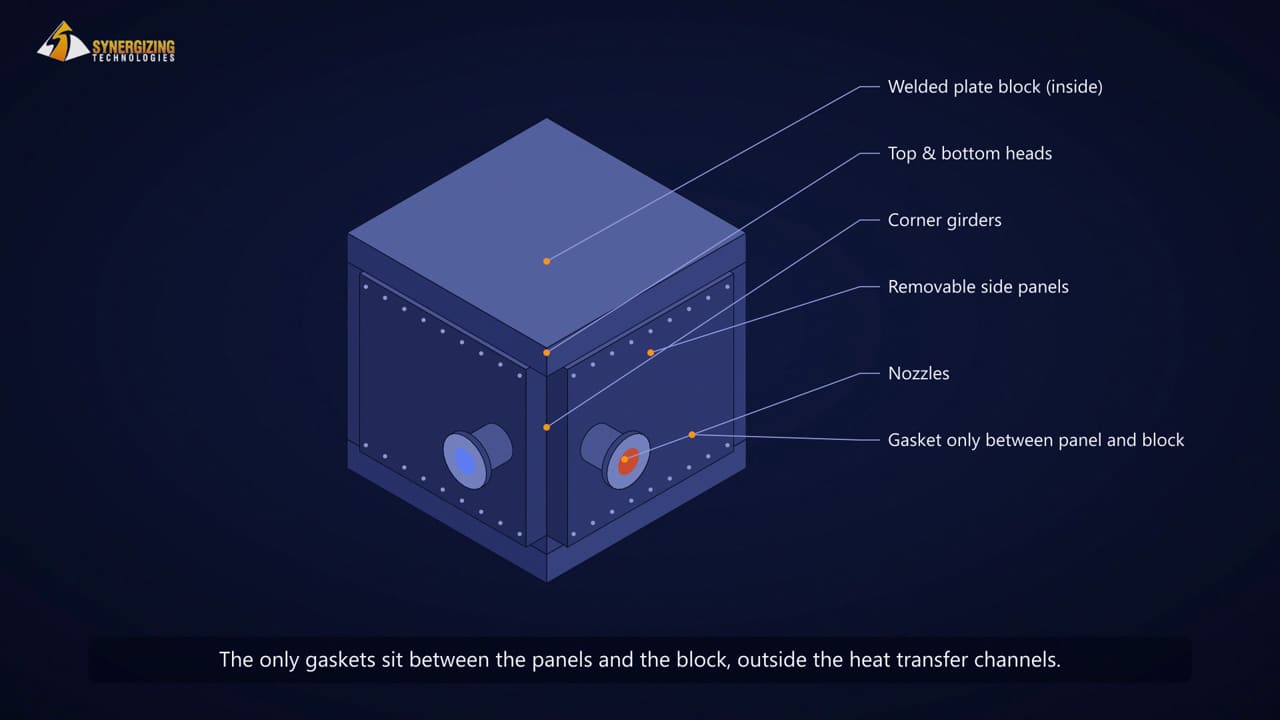
- The block sits in a frame of four corner girders, a top and bottom head, and four side panels bolted around it.
- Each side panel carries the nozzles for one side. Baffles inside the panels turn the flow, so the media make several passes across the block.
- Each pass is cross-flow, but the passes are arranged so the overall flow is counter-current. That gives a close temperature approach.
- The only gaskets are between the side panels and the block, on the outside, away from the heat transfer channels.
What it takes from shell & tube
- A welded pressure boundary. Nothing between the two media depends on an elastomer gasket, so the gasket leaks and gasket compound limits of a plate exchanger do not apply.
- Temperatures above 180 °C, where plate gaskets reach their limit, and higher pressures than any gasketed or semi-welded PHE. We confirm the design limits for each duty.
- Repair on site. If a plate develops a hole, the side panels come off, the leaking channel is found and welded shut, just as a leaking tube is plugged. The unit goes back into service with a small loss of area, covered by the design margin.
- Long life. After many years of service only the plate block needs replacing. The frame, panels and nozzles are reused.
- Mechanical cleaning. With the panels off, every channel on both sides is open for inspection and high-pressure water jetting.
What it adds as a plate exchanger
- 3 to 5 times the heat transfer coefficient of shell & tube, from high turbulence in thin corrugated channels.
- About a quarter to a fifth of the footprint, and much lower weight. Often it fits where the old shell & tube stood, with room to spare, and needs no tube-pulling space.
- Close temperature approach, typically a few degrees, so more heat is recovered from the same stream.
- Less fouling. High wall shear keeps the plates cleaner for longer, so the time between cleanings is longer.
- Lower cost in high alloys. Because the plates are thin and the unit is small, titanium, Hastelloy, 254 SMO and other high alloys cost far less than in a shell & tube of the same duty.
Where the material is expensive, the saving is largest. A shell & tube in Hastelloy or titanium carries several times the metal of a welded block for the same duty.
Where it pays to switch
- Acid coolers and other corrosive media duties, where gaskets fail and shell & tube needs costly alloy.
- Semi-welded or gasketed PHEs that keep leaking at the gaskets, or pitting in the gasket grooves.
- Hot duties above 180 °C, beyond what gasket compounds can take.
- Heat recovery between hot process streams, where a close approach is worth real money.
- Vapour condensing and solvent recovery, in a condenser configuration.
- Refinery, petrochemical and chlor-alkali duties, where space on the structure is short.
When to stay with something else
The welded block is not the answer to every duty. For very high design pressures, or media with long fibres and large solids, other designs suit better: a plate & shell unit for high pressure, or a wide-gap or spiral exchanger for heavy slurries. For clean, low-pressure water duties a gasketed PHE remains the cheapest option. We look at each duty on its own data before proposing a design.
What we need to size one
- The media on both sides, with concentration and any solids.
- Flow rates, inlet and outlet temperatures on both sides.
- Design pressure and temperature, and the allowable pressure drop.
- The present exchanger: type, material and the problem you face with it.
Send us these and we will propose a welded block from our principals, with the material chosen for your media. If you are replacing a shell & tube, we will show the two side by side, so you can compare size, weight and cost.
Read next
Nothing hot is wasted.
Your partners in Heat Transfer Solutions & Sustainable Technologies. Send us your duty and we will size it, or ask us about a unit you already run.
Send an enquiry